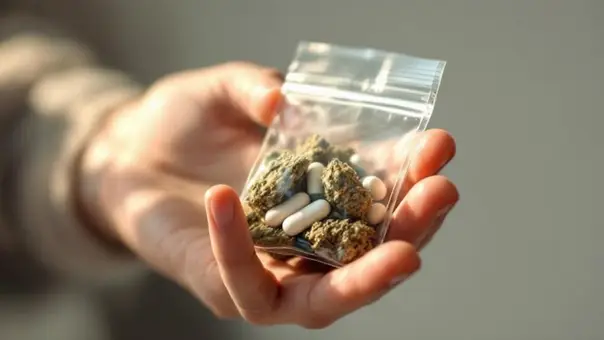
Drug possession in the Netherlands is a criminal offence: the Opium Act (Opiumwet) prohibits possessing, producing, selling, importing and exporting drugs, with no exception for personal use. What the Netherlands has is a tolerance policy (gedoogbeleid): under the Public Prosecution Service’s Opium Act directive (Aanwijzing Opiumwet), possession of up to 5 grams of cannabis, up to 5 cannabis plants, or a user quantity of a hard drug of at most 0.5 gram is normally not prosecuted.
The drugs are seized in every case, the conduct remains an offence, and the guideline no longer helps once the quantity or the circumstances point to dealing. Below we explain what the Opium Act prohibits, where tolerance stops, the maximum penalties and the consequences beyond the sentence.
Mündəricat
Tiryək Qanunu nəyi qadağan edir?
Bringing drugs into or out of the Netherlands, cultivating, preparing, selling, supplying or transporting them, having them present, and manufacturing them. Article 2 sets out these prohibitions for List I (hard drugs) and Article 3 for List II (soft drugs).
List I covers substances with an unacceptable health risk, such as heroin, cocaine, amphetamine and MDMA. List II covers cannabis products and certain sedatives. Since 1 July 2025, List IA allows whole groups of new psychoactive substances (designer drugs) to be banned at once. Use itself is not a separate offence, but you cannot use a drug without having it present. The statutory framework is explained further in our guide to Hollandiyanın narkotik qanunvericiliyi.
What does the tolerance policy allow, and what not?
It concerns prosecution only: the Public Prosecution Service normally does not prosecute user quantities, but it seizes the drugs. Tolerance is published policy, not a right, and the prosecutor can depart from it where the circumstances justify that.
- sirr: up to 5 grams, or up to 5 plants, is normally not prosecuted. With 5 plants or fewer, the directive in principle assumes no professional cultivation.
- Hard drugs: one user dose, such as one pill or one wrap, with a maximum of 0.5 gram, is normally not prosecuted. The directive puts referral to addiction care first.
- Above those amounts: the guideline does not apply. Not every case leads to prosecution, but the starting point reverses.
Quantity is only part of the assessment. The same 5 grams is viewed differently in a pocket at a festival than in a car with scales and small bags. Municipalities can also ban drug use in public by by-law (APV) and fine it; that is not an Opium Act conviction, but it is still an enforcement action.
How do coffeeshops fit in?
Coffeeshops are tolerated if they meet the criteria in the Opium Act directive without exception. These include no advertising, no hard drugs, no nuisance, no admission of or sale to minors, no sale of more than 5 grams per customer per day, and a trading stock of no more than 500 grams.
The directive also contains a residence criterion: only residents of the Netherlands may be admitted. Its enforcement is decided locally by the mayor, prosecutor and police, which is why some border municipalities check residence while Amsterdam admits visitors. A breach can lead to closure by the mayor. Our overview of Hollandiyada qəhvəxana qaydaları şərtləri tam şəkildə müəyyən edir.
The supply side remains illegal: nobody may grow or deliver cannabis in commercial quantities to the “back door”. The closed coffeeshop chain experiment tests a regulated supply in a limited number of participating municipalities, where coffeeshops sell only cannabis from designated licensed growers. Under Article 4 of the Act on the experiment (Wet experiment gesloten coffeeshopketen), it runs for four years from its start in 2025. Outside those municipalities, nothing has changed.
Which maximum penalties apply?
Once a case is prosecuted, the maxima in Articles 10 and 11 of the Opium Act apply. These are the highest penalties the law allows, not the sentences usually imposed.
| Conduct (intentional) | Siyahı I (ağır dərmanlar) | Siyahı II (yumşaq dərmanlar) |
|---|---|---|
| Sahiblik | Up to 6 years or a fifth-category fine (Art. 10(3)) | Up to 2 years or a fifth-category fine (Art. 11(2)); up to 6 years for a large quantity (Art. 11(5)) |
| Cultivating, preparing, selling, supplying, transporting | Up to 8 years or a fifth-category fine (Art. 10(4)) | Up to 2 years; up to 6 years if done professionally or commercially (Art. 11(3)) |
| Import or export | Up to 12 years or a fifth-category fine (Art. 10(5)) | Up to 4 years or a fifth-category fine (Art. 11(4)) |
| Small quantity for personal use | Up to 1 year or a third-category fine (Art. 10(6)) | Up to 30 grams of cannabis: at most one month’s detention or a second-category fine (Art. 11(1) and (6)) |
The quantity that counts as “large” for List II is set by order in council, not in the Act itself. Fine amounts per category are in Article 23 of the Dutch Criminal Code (Wetboek van Strafrecht) and are indexed periodically. Proposals to raise the maxima for large-scale hard-drug offences have been discussed in parliament, but in October 2026 the maxima in the table still apply.
In practice, a first offence with a user quantity usually ends far below these ceilings: a dismissal, a penalty order, a fine or a ictimai xidmət əmri. Prison sentences appear where quantity, professionalism or repetition point to trade.
When does possession become a suspicion of dealing?
When the surrounding facts point to trade, whatever you intended. Investigators look at a familiar set of indicators:
- scales, small bags, sealing equipment or portions of equal weight;
- cash in small notes that does not match your income, which can also lead to a confiscation claim;
- messages on your phone arranging meetings or prices;
- the same total weight divided into many portions;
- cultivation equipment such as lamps, adapted electricity or nutrients, which supports professional cultivation under Article 11(3).
Preparatory acts are punishable in their own right. Under Article 10a, preparing hard-drug production or trafficking carries up to 6 years; under Article 11a, preparing professional cannabis cultivation carries up to 3 years. A case can therefore proceed even when no finished product is found. How the evidence was gathered then becomes central; see our article on Hollandiya cinayət işlərində sübutların toplanması.
What happens after the police find drugs?
The drugs are seized, and you may be arrested and questioned at the police station. Under Article 28c of the Code of Criminal Procedure (Sv), an arrested suspect may consult a lawyer for up to half an hour before the first interview, and has the right to have a lawyer present during it.
What you say in the first interview shapes the file more than anything that follows; our guide on həbs və dindirmə sets out the practical rules. If the suspicion is serious, the suspect must be brought before the examining magistrate within three days and eighteen hours of arrest (Article 59a Sv); see our guide to Hollandiyada məhkəməyəqədər həbs.
The case then ends in a dismissal, a penalty order (strafbeschikking) from the Public Prosecution Service, or a trial before the police judge or a three-judge chamber. A penalty order counts as a finding of guilt. Under Article 257e Sv, you can object to it within 14 days after you received it; our page on the cəza qərarı və prokurorun dinləməsi necə izah edir.
Which consequences outlast the sentence?
For many people, the collateral consequences weigh more than the fine. They are often overlooked when a penalty order is paid without advice.
- Cinayət qeydi: a conviction or an accepted penalty order is registered in the judicial documentation system and is checked when you apply for a certificate of conduct (VOG). See criminal records and the VOG.
- Driving licence: driving under the influence is a separate offence under the Road Traffic Act 1994 (Wegenverkeerswet), and the licensing authority (CBR) can assess your fitness to drive separately. See narkotik və sürücülük.
- Yaşayış icazəsi: for non-Dutch nationals, a conviction can lead to refusal or withdrawal of a residence permit, weighed against the length of lawful residence. See cinayət məhkumluğu və yaşayış icazəniz.
- Closure of premises: under Article 13b of the Opium Act, the mayor can close a home or business where drugs are sold, supplied or present for that purpose, or where preparatory materials are found. This is an administrative measure, independent of the criminal case, and for a tenant it often leads to termination of the lease.
- Müsadirə: the Public Prosecution Service can claim the estimated proceeds of crime in separate confiscation proceedings, often the largest financial consequence.
What should visitors know?
A coffeeshop purchase is tolerated at the counter, and nowhere else. Taking cannabis across the border is export under Article 3 of the Opium Act, whatever the quantity, and an offence under the law of the country you enter.
Visiting several shops in one day, or buying for a group, can produce a quantity above 5 grams that is treated as possession for supply. Buying for others, even without profit, is supply. Street drugs are unregulated and may contain a List I substance, with a far lower tolerance threshold and a far higher maximum penalty.
What determines the sentence?
Within the statutory maxima, the court weighs the substance, the quantity and the context. Aggravating factors include previous convictions, dealing near schools, a professional operation and the involvement of minors; mitigating factors include a clean record, a small quantity and a treatment programme for addiction that has already started.
Şübhəli şəxs kimi nəyi yoxlamalısınız?
- Did you consult a lawyer before your first police interview (Article 28c Sv)?
- Is the quantity within the directive’s limits of 5 grams of cannabis or 0.5 gram of a hard drug?
- Which indicators of dealing are in the file, and how were they obtained?
- Have you received a penalty order, and is the 14-day objection period still running?
- What does a conviction mean for your VOG, driving licence or residence permit?
What should you check as an owner or tenant of premises?
- Has the mayor announced or ordered a closure under Article 13b of the Opium Act?
- What is the deadline for an objection (bezwaar) and a request for a provisional measure?
- Were the drugs present for sale or supply, or only for personal use?
- Is the closure proportionate, given your personal circumstances and any children living there?
- Has the landlord started proceedings to end the lease?
What can we do for you with a drug case?
Bizim cinayət hüququ komandası defends clients in Opium Act cases, from the first police interview to trial and appeal.
- We assist you before and during the police interview.
- We review the file for the evidence of dealing and the way it was gathered.
- Biz 14 gün ərzində cərimə qərarına etiraz edirik.
- We defend you at trial and in confiscation proceedings.
- We object to a closure order by the mayor and request a provisional measure from the administrative court.
xülasə
- Drug possession is an offence under Articles 2 and 3 of the Opium Act; the tolerance policy only concerns prosecution.
- Up to 5 grams of cannabis, 5 plants or 0.5 gram of a hard drug is normally not prosecuted, but always seized.
- Maximum penalties run up to 12 years for importing or exporting hard drugs (Article 10(5)).
- Indicators such as scales, cash and messages turn possession into a suspicion of dealing.
- A conviction or penalty order can affect your VOG, driving licence, residence permit and home.
Tez-tez soruşulan suallar
Hollandiyada kannabis qanunidirmi?
No. Possession is an offence under Article 3 of the Opium Act. Under the Opium Act directive, the Public Prosecution Service normally does not prosecute possession of up to 5 grams or up to 5 plants, but the cannabis is always seized.
How much hard drugs can I carry without prosecution?
The directive treats one user dose, with a maximum of 0.5 gram, as a quantity for personal use that is normally not prosecuted. Possession remains an offence and the drugs are seized.
Can I take cannabis bought in a coffeeshop abroad?
No. Taking cannabis out of the Netherlands is export under Article 3 of the Opium Act, punishable by up to 4 years, and usually an offence in the country you enter as well.
Can I object to a penalty order for drug possession?
Yes. Under Article 257e of the Code of Criminal Procedure, you can object within 14 days after you received the penalty order. The case is then heard by the court. Paying the order means you accept it.